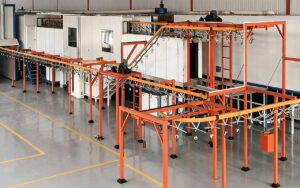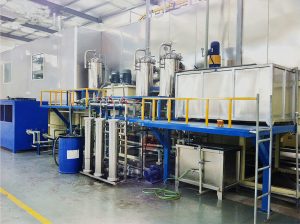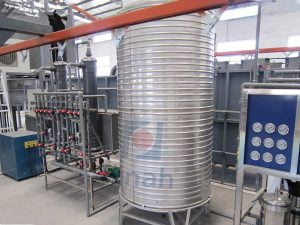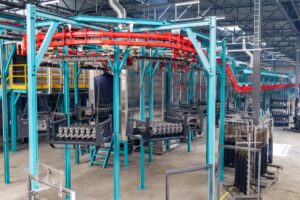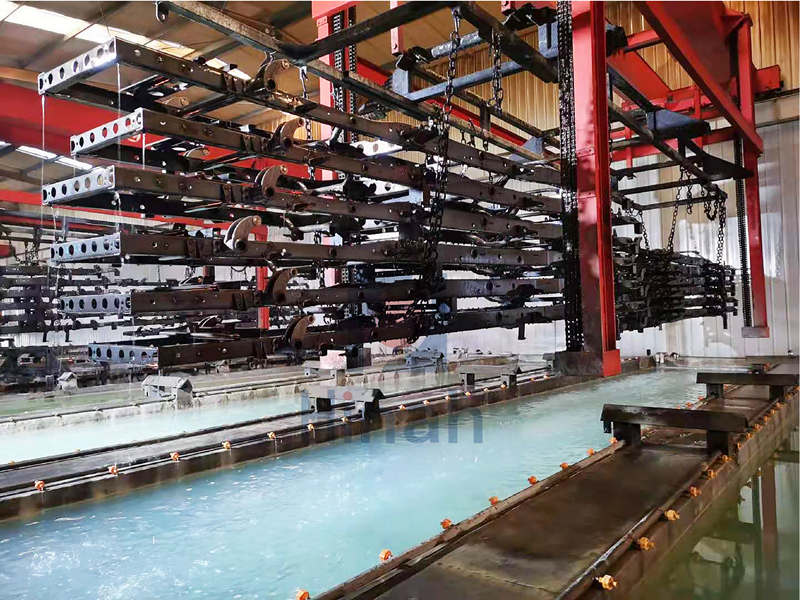
An e-coating line delivery takes roughly six to ten months from purchase order to first good part. Twelve stages run in sequence: design, fabrication, factory testing, shipping, installation and commissioning. Suppliers normally finish the equipment in twelve to sixteen weeks. Freight, customs clearance and site work consume the rest of the time — and that is where most projects lose weeks.
This page breaks the sequence down, stage by stage. It shows who leads each stage, what you have to prepare, and where schedules actually slip.
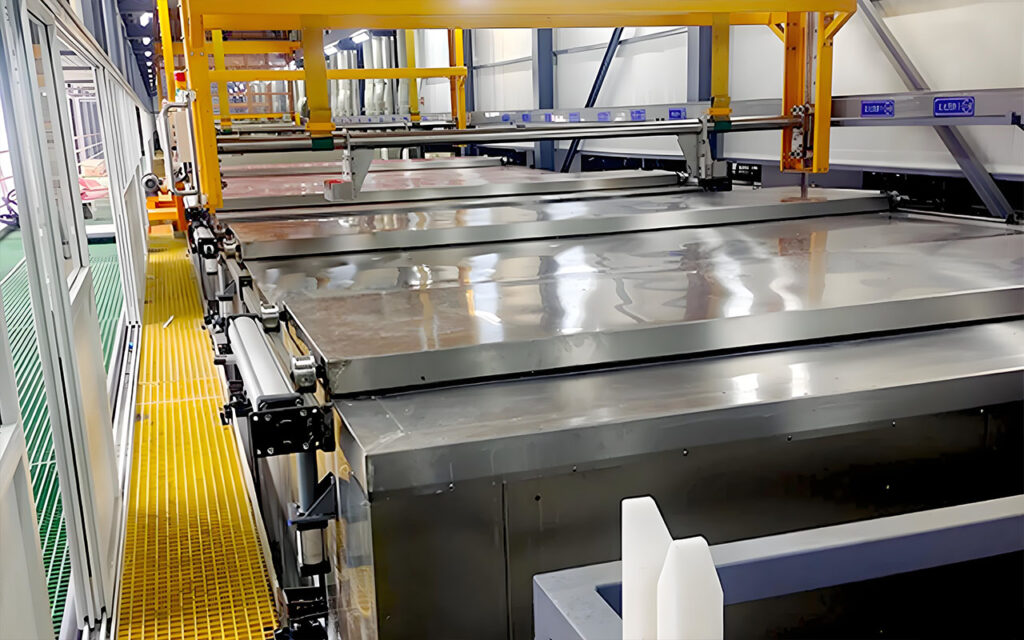
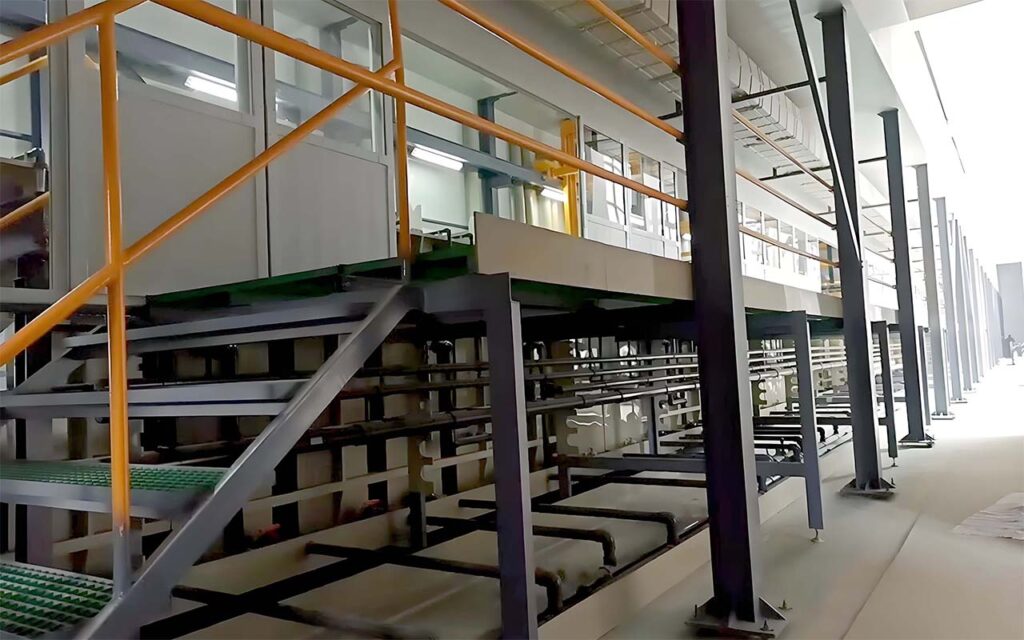
What “From PO to First Good Part” Actually Means
A purchase order is not a delivery date. In an e-coating line delivery project, four different kinds of work sit between the two:
– Engineering — turning your parts, output and coating spec into an e-coating line design
– Fabrication — building tanks, ovens, conveyor and electrical cabinets
– Logistics — testing, packing, ocean freight, import clearance
– Site work — installation, commissioning, bath build-up, training
Only the first two happen at the supplier’s factory. The last two happen at yours, and you control them least — unless you agree the schedule in writing before you sign the contract.
A single contract with one responsible party removes the most common failure mode in coating projects: four vendors, four schedules, and nobody accountable when the conveyor arrives three weeks after the tank.
The 12 Stages of an E-Coating Line Delivery Project
The table below shows a typical e-coating line delivery sequence for a mid-size line, with indicative durations. We fix the actual dates per project and write them into the contract schedule.
| # | Stage | Typical duration | Who leads | What you provide |
|---|---|---|---|---|
| 1 | Kick-off and requirement freeze | 1 week | Joint | Part drawings, target output, coating spec, site layout |
| 2 | Process design (pretreatment → e-coat → cure) | 2–3 weeks | Supplier | Approval of process flow and tank sequence |
| 3 | Mechanical and electrical detail design | 2–3 weeks | Supplier | Site services data: power, water, drainage, compressed air |
| 4 | Fabrication (tanks, oven, conveyor, cabinets) | 8–12 weeks | Supplier | — |
| 5 | Pre-assembly and wiring at works | 2–3 weeks | Supplier | — |
| 6 | Factory acceptance test (FAT) | 3–5 days | Joint | Travel or remote attendance, sign-off criteria |
| 7 | Disassembly, crating, ISPM 15 treatment | 1–2 weeks | Supplier | Shipping terms confirmation |
| 8 | Ocean freight | 3–7 weeks | Supplier / forwarder | Consignee details, import licence |
| 9 | Import clearance and inland delivery | 1–3 weeks | You / forwarder | Customs broker, unloading equipment |
| 10 | Mechanical installation | 3–5 weeks | Supplier crew + your fitters | Power, water, drainage ready; lifting equipment |
| 11 | Commissioning and bath build-up | 2–4 weeks | Supplier | Chemicals, DI water, test parts |
| 12 | Operator training and first good part | 1 week | Joint | Trained operators, production parts |
Two Stages You Cannot Compress
Stages 4 to 6 are the only ones you cannot compress much. No amount of overtime pays down the fabrication time of a curing oven and an e-coat tank. So if a supplier promises a four-week build, ask what they plan to skip.
Three Stages That Decide Your Real Date
Stages 8 to 10 decide the date you actually start production. Ocean freight swings by three to four weeks depending on route and season, and clearance can stall on a single missing certificate. A supplier who quotes a delivery date without separating these three stages quotes a hope, not a schedule.
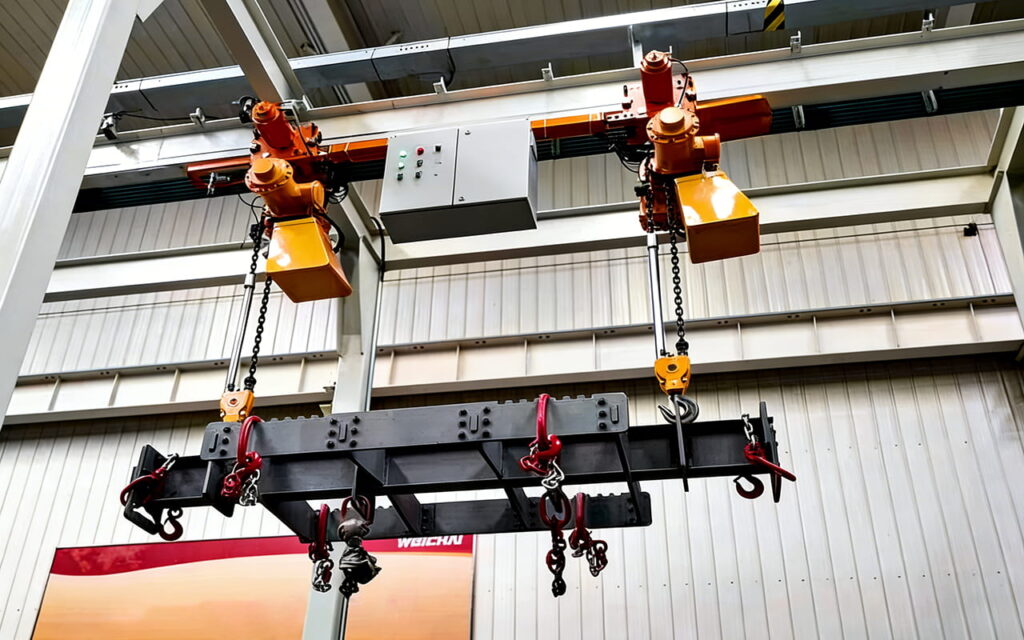
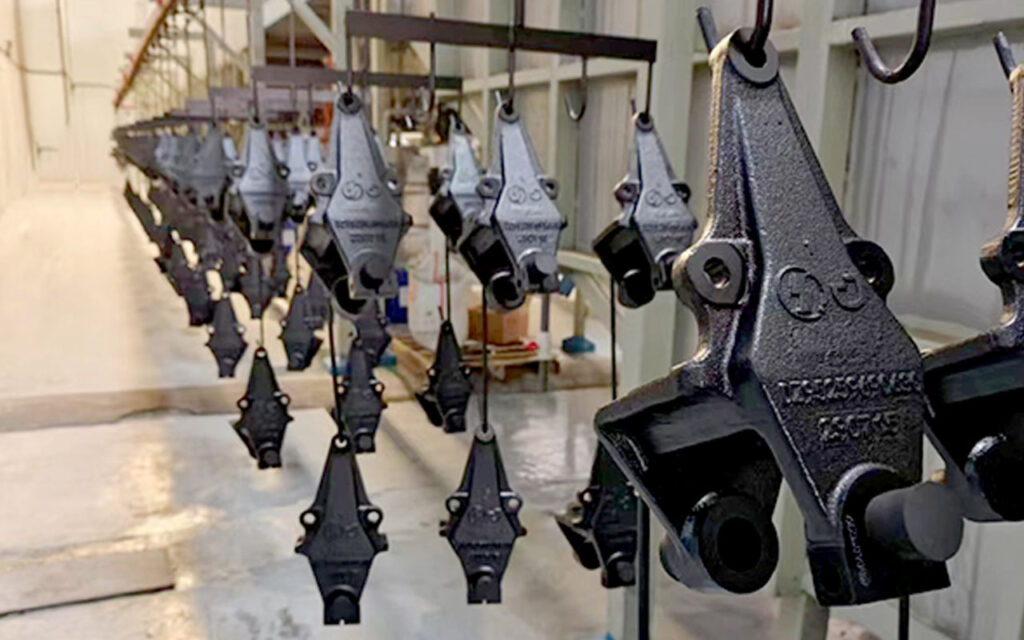
Where E-Coating Line Delivery Schedules Actually Slip
Across export e-coating line delivery projects, delays cluster in four places. None of them involve fabrication.
1. Site Readiness
This causes more delays than anything else. The e-coating line arrives and the power supply has not reached the required capacity, or the pit is unfinished, or the drainage sits at the wrong elevation. Meanwhile a line standing in its crate on your floor costs money every week and earns nothing.
Fix: sign off a site readiness checklist before stage 7. Not a verbal confirmation — a document with photographs.
2. Utility Capacity Discovered Late
An e-coating line draws a large electrical load, and the rectifier, oven and chiller together often exceed what an existing plant assumed. If the transformer upgrade only surfaces during commissioning, the line waits for the utility company, not for the supplier. Our note on the space and power a standard automotive e-coating line requires lists the figures to confirm.
Fix: confirm the actual available capacity in stage 3, not stage 11.
3. Chemical and DI Water Supply
Bath build-up needs the right chemicals at the right concentration, and DI water at a specified conductivity. Teams often order both late, and cannot improvise either one. As a result, the bath waits even when the tanks stand ready.
Fix: agree the chemical spec and the water quality requirement at design stage, then place the order so it lands before installation finishes.
4. Customs Documentation
Missing or inconsistent paperwork — value declaration, certificate of origin, wood packaging marking — can hold a container for weeks.
Fix: mark all wooden crating to ISPM 15 and review the document set before the container leaves, not after it arrives.
What You Need Ready Before the Line Ships
Eight items decide whether installation starts on the agreed date.
| Item | Requirement | Why it blocks |
|---|---|---|
| Power | Capacity and voltage confirmed against the load schedule | Rectifier and oven cannot be energised |
| Water | Supply pressure and DI water quality | Bath build-up cannot start |
| Drainage | Elevation and flow rate at the discharge point | Rinse stages cannot operate |
| Compressed air | Pressure and dew point | Pneumatics and conveyor |
| Floor | Level, load rating, anchor positions | Installation cannot begin |
| Lifting | Crane or forklift capacity for the heaviest module | Unloading stalls at the door |
| Access | Door width and route from container to position | Modules cannot be moved in |
| Storage | Covered space for crated modules | Moisture damage, insurance disputes |
If you leave any row unconfirmed before shipment, the schedule moves — and it moves by weeks, not days.
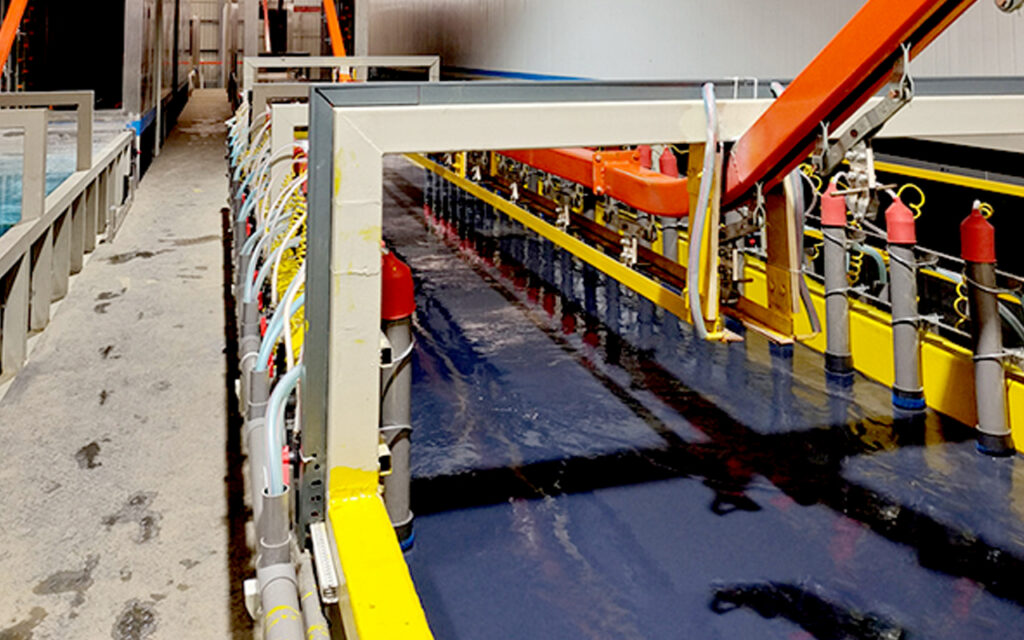
What Stays With You After Handover
You then have a commissioned line, trained operators and a measured first good part. What matters next is whether the supplier still answers at month eight, when a rectifier faults or a UF membrane clogs.
Fix three things in the contract rather than accepting a promise in a meeting:
– Spare parts package — the specific list, not “a set of wearing parts”
– Response time — by channel and by region, with a named contact
– Warranty scope — which components the warranty covers, which parts count as consumables, and for how long
Hinah has exported coating lines for twelve years, with a repeat-order rate of 60% against an industry average of 20.4%. No marketing department can manufacture a repeat order, and that is the only after-sales metric worth reading.
Frequently Asked Questions
How long does e-coating line delivery take?
Typically six to ten months for a mid-size e-coating line. Fabrication runs twelve to sixteen weeks; freight, clearance and site work fill the rest. Of every variable in the schedule, site readiness moves the most — not the supplier.
Who installs the line — your team or mine?
Usually a supplier crew supervises while a local team performs the mechanical work, and the supplier’s engineers handle alignment, electrical connection and commissioning. Write into the contract who travels, how many people come, and who pays for flights and accommodation; then nobody argues about it later.
What is FAT and do I need to attend?
Factory acceptance test: the supplier assembles and runs the line at their works before packing. That gives you the last chance to find a fault while the equipment still sits in one place with tools and people around it. Attend in person if you can. If you cannot, agree in advance what the supplier records and who signs off.
What if the line does not pass commissioning?
Define acceptance criteria in the contract before the project starts — film thickness range, cure verification, conveyor speed accuracy, safety function test. Without written criteria, “it works” becomes an opinion.
Is operator training included?
It should be, and it should come with an agenda. Five days is a normal allowance: process control, bath maintenance, troubleshooting, safety and daily checks. Training squeezed into commissioning, while engineers debug the line, does not stick.
Which spare parts should I stock from day one?
At minimum: pump seals and diaphragms, filter elements, UF membrane modules if used, conveyor chain and trolley wear parts, heating elements and thermocouples, and a full set of fuses and contactors matching the cabinet. Ask the supplier for the recommended list in writing with part numbers.
How should shipping risk be allocated?
Under Incoterms® 2020 (ICC), risk transfers at a defined point — commonly FOB at the port of loading or CIF at destination. The Incoterm decides who insures the cargo and who carries the loss if a container arrives damaged. Agree it before pricing, because it changes the quoted number.
What standards should the equipment comply with?
For European destinations, expect machinery safety under EN ISO 12100 and the CE marking regime, electrical assemblies to IEC 61439, and quality management to ISO 9001:2015. Wooden packaging must carry ISPM 15 (IPPC) marking, or customs can refuse it at the border.
Next Step: A Schedule You Can Hold Us To
If you plan a KTL line and want a project-specific e-coating line delivery schedule rather than a range, send your part drawings, target output and site layout.
We will return a stage-by-stage e-coating line delivery timeline with the dates we will put in a contract.
Hinah supplies complete electrophoretic coating lines, plus powder and liquid coating lines. We handle design, fabrication, shipping, installation and commissioning under one contract, with a single responsible party from order to first good part.