Throughput is often discussed as a number, but in an e-coating operation, it is the result of how smoothly the entire line works together. Simply increasing conveyor speed rarely delivers sustainable gains. In many cases, it creates new bottlenecks, quality risks, and unplanned downtime.
This is where a monorail e-coating line stands apart. By replacing batch-based movement with a continuous, controlled flow of parts, monorail systems are designed to keep production moving at a stable rhythm. From pretreatment to the e-coat tank and curing ovens, every stage is synchronized to reduce idle time, handling delays, and process imbalance.
Rather than relying on speed alone, a monorail e-coating line improves throughput through system-level efficiency—combining automation, optimized part movement, and consistent coating quality. Understanding how these elements work together explains why monorail systems are widely used in operations where both output and reliability matter.
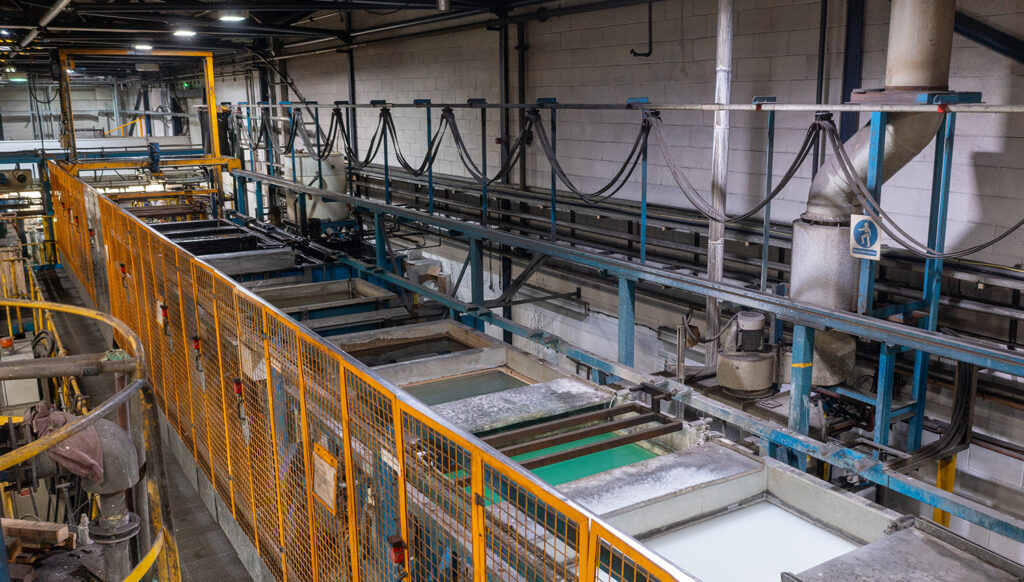
Continuous Flow: The Core Advantage of a Monorail E-Coating Line
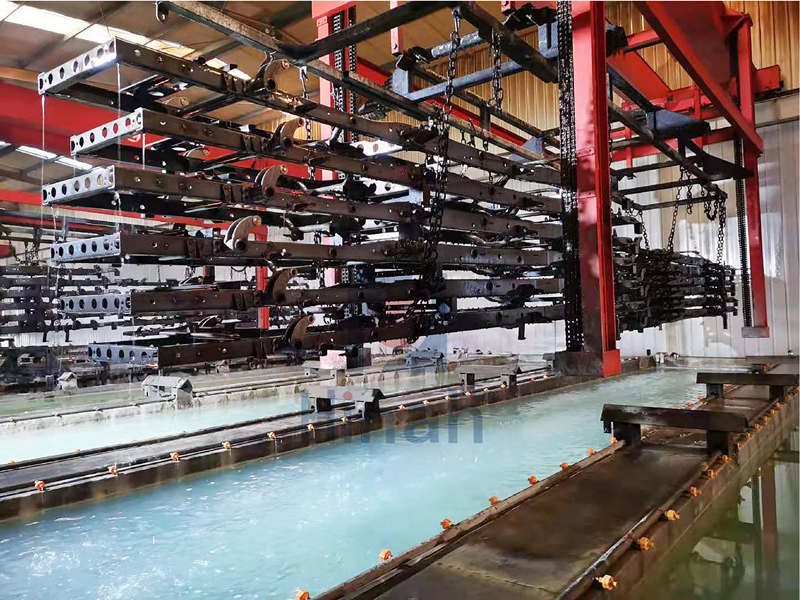
At the heart of higher throughput in a monorail e-coating line is continuous movement. Unlike batch systems that rely on start-and-stop loading cycles, a monorail conveyor carries parts through the entire process on a single, uninterrupted chain. Once parts enter the line, they move forward at a controlled and predictable pace.
This continuous flow eliminates the hidden downtime common in batch operations—waiting for racks to fill, pausing for manual transfers, or stopping the line between process stages. Pretreatment, e-coating, rinsing, and curing are no longer isolated steps but parts of one synchronized process. Each section of the line is timed to support the next, keeping equipment utilization consistently high.
Equally important, continuous flow creates a stable production rhythm. Workers, automation systems, and process controls all operate around a fixed takt time, reducing variability that can slow output. Over time, this stability allows the line to run faster without sacrificing control, making continuous flow the foundation for reliable throughput improvement in a monorail e-coating line.
Automation & Control in a Monorail E-Coating Line
Automation plays a critical role in turning continuous movement into measurable throughput gains. In a monorail e-coating line, programmable controls manage conveyor speed, rack spacing, and dwell time at each process stage, ensuring parts move through pretreatment, the e-coat tank, and curing ovens with precise timing. This level of control minimizes process variation and reduces the need for manual intervention, which is often a source of delays and errors. By keeping each section of the line balanced and synchronized, automation allows the system to maintain a high, steady output rate while remaining adaptable to different part sizes and production requirements.
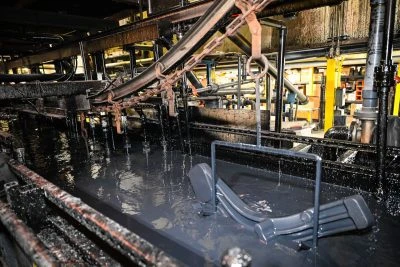
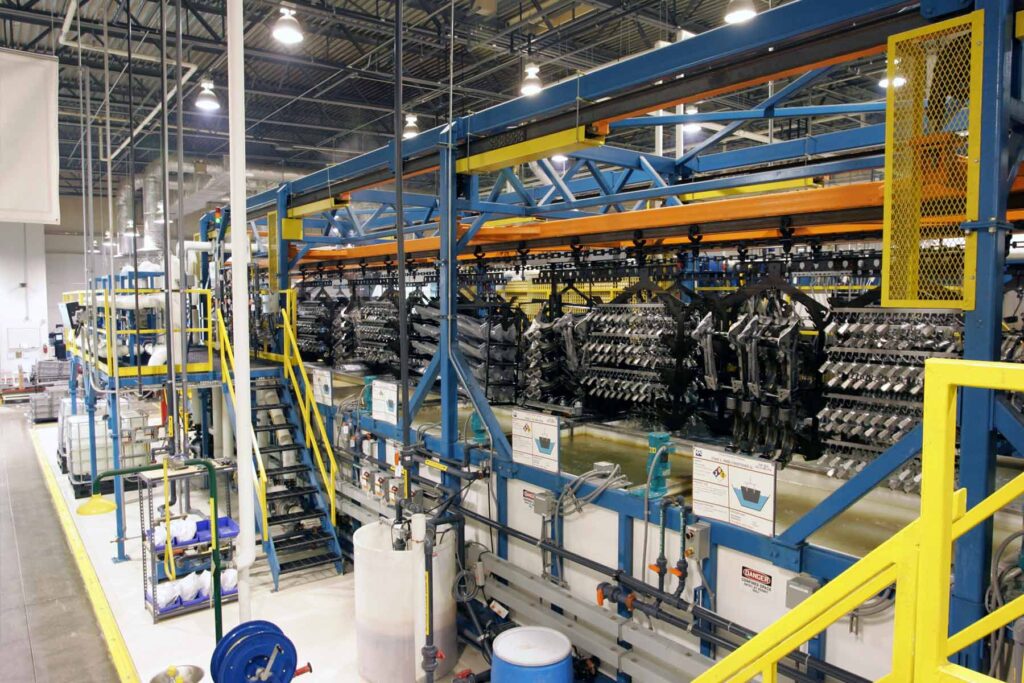
Optimized Rack Loading to Maximize Throughput
One of the most direct ways a monorail system increases output is through smarter rack utilization. A monorail e-coating line can be designed to support high-density racking, allowing more parts to be processed in each pass through the tanks and ovens without extending cycle time. By carefully controlling part spacing and orientation, the system makes full use of available immersion volume while maintaining proper solution access and electrical contact.
In addition, techniques such as rack bunching allow multiple racks to move through key process zones as a group. This approach increases production density, especially for smaller or lightweight components, and helps manufacturers boost parts-per-hour without expanding the physical footprint of the line.
Consistent Quality That Supports Higher Line Speed
Higher throughput is only sustainable when coating quality remains stable. In a monorail e-coating line, features such as enhanced tank circulation prevent paint settling and ensure uniform coating conditions even at elevated production rates. This stability reduces the risk of defects that would otherwise force speed reductions or rework.
Programmable dip curves and controlled part movement, including rotation where needed, further support consistent film build on complex geometries. By maintaining uniform coverage at higher conveyor speeds, the system allows manufacturers to increase throughput confidently—knowing that quality control is built into the process rather than managed as a corrective step.