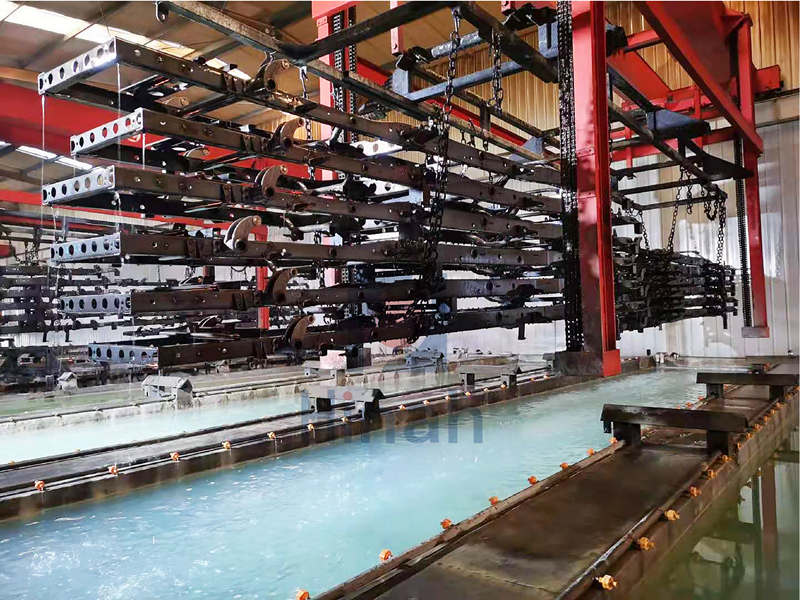
Bubbles that appear after the curing oven rarely come from bad paint. In most cases they are water that never left the film before the surface closed. Cut one open and you find a smooth dome over a dry cavity, with clean metal behind it, no carbon ring at the rim, and no crater in the substrate. That pattern tells you the gas formed late, while the film was already partly set. On a coated part, most electrocoating bubbles of this kind are trapped water, not trapped air, and the fix sits in the oven rather than in the tank.

What Do Curing Bubbles Look Like on a Finished Part?
A thin dome, clean metal, and no crater at the rim.
The roof of the blister is thin. It may stay intact or crack open in handling, and the diameter is usually a few millimeters. The film over the dome is thinner than the surrounding area, and a gauge will show it. Position matters more than count. Look at flat top faces, corners, and the inside of stiffening ribs, where film builds thicker and drains poorly. Vertical faces often show far fewer bubbles, because water can still run off before the oven. That distribution is the first clue, and it points to trapped liquid rather than contamination on the surface.
Why Does the Film Enter the Oven Wet, Not Dry?
A part leaves the last rinse with water inside the film, not only on it.
The film is porous at this stage. That porosity is useful in the tank, because it lets current pass through the deposited layer. It becomes a problem in the oven, because the same pores now hold water. Flash-off removes surface water in minutes. Water deeper in the film needs heat and time to diffuse out. Once the film crosslinks at the surface, the escape route closes. Water left inside turns to vapor and lifts the skin.


Why Does a Thick Film Trap More Water Than the Oven Can Pull Out?
More film means more water and a longer diffusion path.
Film growth slows on its own once the deposited layer insulates the part. Research at the New Jersey Institute of Technology described this self-limiting behavior decades ago, and it still explains most thickness variation on a line. Raise voltage, extend dwell time, or run a hotter bath, and the film builds thicker. A thicker film holds more water, so it needs a longer path out and a gentler ramp. This is why the same electrocoating line can run clean for months, then bubble after a single voltage change.
How Does Ramp Rate Decide Whether Water Escapes or Blows Through?
The peak matters less than the path taken to reach it.
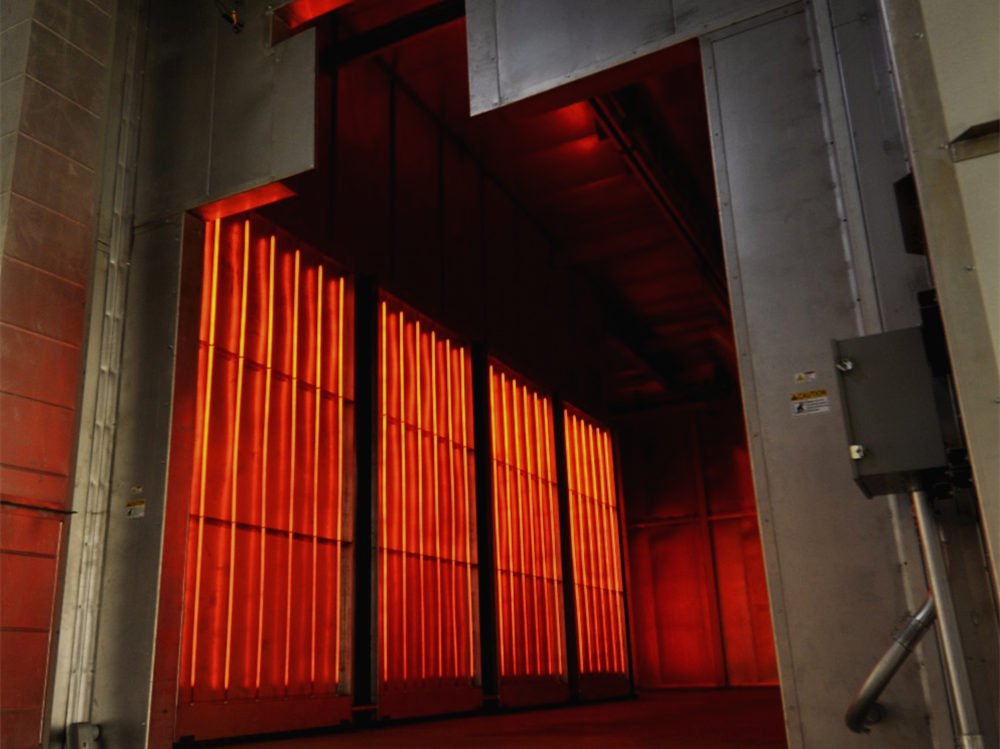
Cure schedules commonly target a metal temperature around 175 to 190 °C for 15 to 30 minutes, as EPA training material on electrocoating describes. Radiant zones heat the surface first, so a skin forms before the water underneath has moved. Convection with real air movement does the opposite, because it carries vapor away from the surface. A short hold near the boiling point of water, placed before the final cure zone, gives vapor a chance to leave through an open film. Two curing ovens with the same setpoint can still behave differently, because air balance matters as much as temperature. Ovens with one fast ramp and no hold zone are the ones that bubble.
Do Castings, Welds and Phosphate Layers Bring Their Own Gas?
Not all of the gas in an electrocoating oven comes from the paint.
Castings and welds can hold air in porosity, and that air expands as the part heats. Blind holes and overlapped joints trap air the same way. A phosphate layer carries water of hydration, and it releases that water during cure. Zinc-rich surfaces add another path, because the metal itself can react at cure temperature. If bubbles cluster on castings or on one weld cell, the film is probably fine. The substrate is feeding the oven, and no change in the bath will stop it.
How Do You Separate Electrocoating Bubbles From Pinholes and Craters?
Each defect points to a different stage of the process.
Pinholes open during deposition. They come from hydrogen at the surface, and they are visible before the part reaches the oven. Craters have a raised rim and a low-energy center, and they follow contamination. A curing bubble has a dome, a cavity, and clean metal behind it. Section one under a microscope and the difference is obvious. Getting this wrong sends you to the wrong department. A bubble is an oven and film problem, a pinhole is a deposition problem, and a crater is a cleaning problem.
What Should You Change First on an Electrocoating Line?
Start with the cheapest fix, then work upstream.
Add flash-off time, then check that the part is genuinely dry at the oven entry. Look at zoning next, and ask whether the first zone heats the surface faster than the core. Measure film thickness on the parts that bubble, not on the ones that pass. If bubbles sit on castings, pre-bake them. If they follow a thick-film area, bring film back into range before you touch the bath. Only then review solids, temperature and solvent balance in the tank. Most electrocoating bubble problems are a timing problem rather than a chemistry problem, so measure the ramp before you change the bath.
Bubbles after the oven are water that ran out of time. Dry the film before it densifies, hold a gentle ramp through the boiling point, and keep film thickness in range. Those three habits keep the defect off the part.