Reduce Costs in Electrocoating: Environmental Technology Equipments Explained
While electrocoating is renowned for its uniform finishes and corrosion resistance, many manufacturers overlook the hidden costs lurking in their operations. Beyond paint consumption and
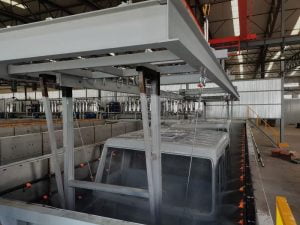
Advanced Filtration Technology in E-Coating Line: Protecting Paint Bath
E-coating line demands flawless paint bath purity to achieve uniform, defect-free finishes. Even microscopic contaminants—metal shavings, oils, or dust—disrupt deposition, causing pinholes, uneven textures, and
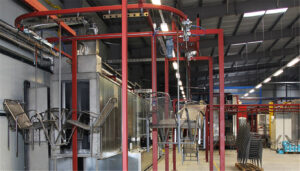
How Does E Coating Aluminum Transform Industrial Parts?
In harsh industrial environments, aluminum parts face relentless challenges—corrosion from moisture and chemicals, uneven wear on complex geometries, and ever-tighter regulations around environmental impact. Traditional
E-Coating Line Solutions for Ultra-Durable Car Parts Protection
In an era where vehicles face increasingly harsh environments—from road salt to extreme temperatures—the demand for long-lasting car parts has never been higher. This is
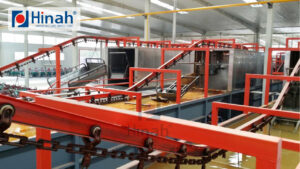
The Critical Role of Electrical Conductivity in Electrocoating Line Performance
Electrical conductivity is a cornerstone parameter in modern electrocoating line operations, directly influencing coating quality, process stability, and production efficiency. In cathodic electrodeposition systems, conductivity
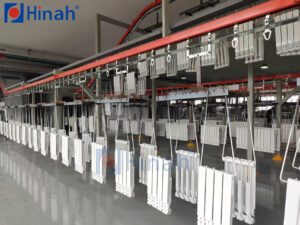
Exploring the Secret of Orange Peel in Electrophoretic Coating
Let’s talk about a problem that keeps coating engineers up at night: orange peel. You know that frustrating moment when a freshly coated surface dries,
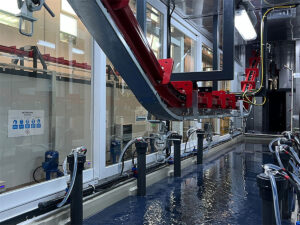
The Hidden Cost Most E-Coating Line Missing – Are You Paying It?
Did you know your e-coating line might be quietly siphoning profits while you’re busy chasing production targets? Most manufacturers obsess over upfront equipment costs or
Electrophoretic Coating Secrets: Achieve Zero-Defect Surface Finishing
Imagine investing time, effort, and resources into a coating process, only to end up with imperfections—craters, uneven thickness, or adhesion failures. Frustrating, right? In the
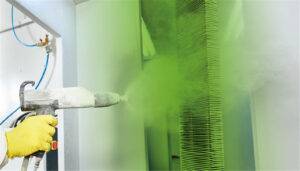
E Coating vs Powder Coating: Which Suits You Better?
In manufacturing, the right surface coating isn’t just about aesthetics—it’s a critical defense against corrosion, wear, and environmental damage. Yet, with options like e coating
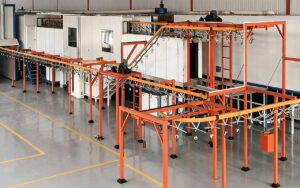
E-Coating Line Delivery: From PO to First Good Part
An e-coating line delivery takes roughly six to ten months from purchase order to first good part. Twelve stages run in sequence: design, fabrication, factory
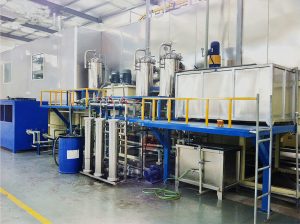
What Causes Low UF Permeate Flow in E-Coating?
A gauge reading 8% under baseline usually sends the shift straight to a cleaning cycle. The membrane is often innocent. Low UF permeate flow is
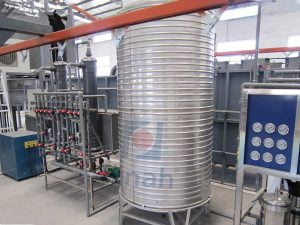
How Often Should E-Coat UF Membranes Be Cleaned?
A UF loop gives its first warning as a number nobody writes down. Permeate flow on the rinse header slips a few percent a week.
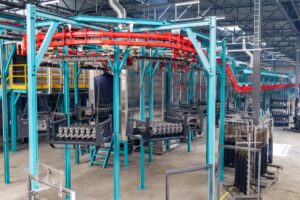
What Causes E-Coat Streaks on Metal Parts?
Sixty steel brackets leave the oven in one rack, each leg carrying the same four pale bands in the same place. The gauge reads thin
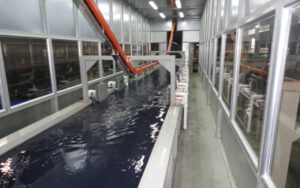
Why Does E-Coat Bath pH Keep Changing?
At 06:00 the meter reads 6.1. By the end of the second shift it reads 5.75, and nobody touched a setpoint. That swing is normal
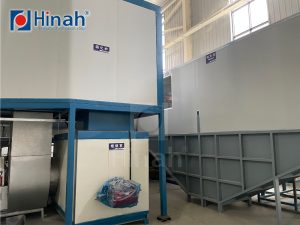
Why Does Electrocoating Bubble During Curing?
Bubbles that appear after the curing oven rarely come from bad paint. In most cases they are water that never left the film before the
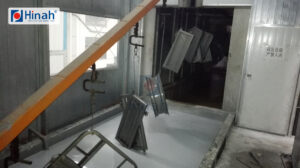
Why Does Cratering Occur in an E-Coat Line?
A crater looks like a shallow bowl pressed into the film. The rim sits high, the center is bare, and the paint around it is
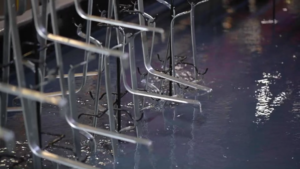
Why Are Some Areas Bare After Electrophoretic Coating?
A metal part comes out of the dip tank, but one corner remains bare. Another part has a complete coating on the outside, yet the
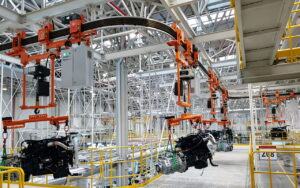
Why Does E-Coat Line Paint Peel or Lose Adhesion?
Peeling rarely starts with the peeling itself. By the time an e-coat film lifts from the metal, the original problem may have started several stages